Tuesday, September 29, 2015

True Grit - American Mythology

While they glorify the history of the American frontier, Western stories and films play a key role in American Mythology. Classically known for gun fights, stage coach robberies and cowboy and indian fights, Americans feel a sense of identity when watching these films because they feel it is a part of their past, glorified though it may be, Westerns are simply entertaining. 

Westerns are a great part of American mythology. They showcase how we look back on our history of the frontier, shaping the land we now call home. Gun fights were sometimes romanticized, but always prominent, oftentimes measuring the steel of a man and his worth. This also gave man the power to either bring or serve justice on his own accord quickly, which would often times bring down no discipline on his own head. This is something that clearly does not stand in todays standards, but is instead surprising if one even knows how to fire a gun let alone own one. The sense of justice has changed dramatically since the dawn of the western, with a complete new set of rules and values, yet so many of us still find entertainment and value in these films because the characters are strong in their beliefs and the sense of community is something of nostalgia for some. No longer do people ban together to raise a town from the ground up, or defend each other as seen in these classic American myths. Truly they are a wonderful snapshot of the ideal West that so many Americans see themselves stemming from.

Western films can typically be whittled down to one battle: civilization versus wilderness. These odds can come in a variety of forms and can be represented by people versus the elements or people versus people and many typical plots are driven by revenge. Most western films are centered around male lead characters, both on the hero and villain side, but it is not uncommon to see women in supporting roles, as was the time period.

True Grit is a true reflection of American Mythology. From the setting of the civilized, yet not fully developed town to the forest and desert like landscapes, the plot is full of rough riding characters that fit the bill to many western films. The main character, Mattie, is motivated by the ever classic plot of revenge, to seek vengeance for her father’s death. The story also glorifies men in all their manly glory, who display “true grit.” One of these men is the gun slinging, more likely to shoot than ask questions, Marshall Rooster Cogburn. While isn’t a good guy or bad guy, he fills the role of both and accomplishes his own self interested goals. He is a drunkard and has a questionable history, yet the audience still takes to him as one of the good guys. We pardon him of his questionable past because he displays throughout the film that he truly is a man of “true grit” and he clearly does care for Mattie on their journey for revenge.

Mattie fits the mold to the justice seeker, truly believing that she will be bringing justice to her father’s death, but truly she is seeking revenge. Yet, her actions are warranted when we look at the kinds of characters she is met, such as the ruthless killers in the Ned Pepper gang, who would sooner cut your throat than talk. The audience is okay with Matties revenge and morals come from a sense of justice, thus feeling okay and rooting for her success in the death of her father’s killer.


In the end, True Grit is the perfect example of an American Mythology story, showcasing the history of the frontier in an up close look into a story of revenge and justice.


Stefan Zweig and Wes Anderson

The writing of Stefan Zweig can be clearly admired in Wes Anderson’s films, but specifically I will focus on The Grand Budapest Hotel. Both the setting and the dialogue were both heavily inspired by Zweig’s writing, sharing mood and theme. One of Zweig’s almost, rose colored glasses themes was shown visually in The Grand Budapest Hotel with a very clear pastel color pallet through the entire film, which I found to be a very effective use for both mood and storytelling, giving it an almost storybook type feel to the film. The character introductions, or rather the character introducing the world and the exposition in Zweig’s writing is seen well in the Grand Budapest Hotel, the way the period is revealed along with the exposition. Truly it is like watching a story book come to life.

Almost immediately after I began reading Stefan Zweig’s works, such as Twenty-four Hours in the Life of a Woman, A Star Above the Forest, The Governess and A summer Novella, I was completely immersed in the form of writing and the unique characters. It is easy to see how Wes Anderson’s films and Zweig’s stories coalesced so well. Each were very connected and Anderson’s film style complements Zweig’s writing style quite nicely, as a perfect translation from written word into film. It is both Zweig and Anderson’s hyper sensitive attention to detail that crosses over so nicely. Each was perfectly designed, each detail belonging to the setting and world in which it belonged. In Zweig’s work, painting pictures in the readers mind of the setting in clear yet simply beautiful detail and in Anderson’s a lovely composition to behold, simple yet precise and meticulously planned. Even if the setting might not be relatable, the reader or viewer could feel right at home, noticing details and taking in the setting effortlessly.

The idealized worlds Anderson creates are well crafted and incredibly designed, which is clearly a common thread with Zweig’s works, sharing a sort of surrealism. This comes in both aesthetic and verbal forms as well as social situations. For instance, in Twenty-four Hours in the Life of a Woman, we begin following the story of the narrator, which we are introduced to, then we switch to follow the story of Mrs. C as she takes the story over. Nearly the same instance happens in The Grand Budapest Hotel, shifting from our introduced narrator, who we learn later comes back, to our main character Mr. Gustave, who becomes our new narrator that too could effortlessly fit right into one of Zweig’s stories.


The impression Zweig seems to have had on Anderson seems clear from the first 5 pages of any of Zweig’s works, but in my opinion has become a brilliant inspiration to Wes Anderson’s already fantastic stories. Each creative director’s works can be enjoyed separately, but I have enjoyed the comparison and contrast to each artist’s work. The inspiration has brought success and in turn has inspired me. I believe this to be a perfect example that steel sharpens steel.


Tuesday, September 1, 2015

Eternal Sunshine of the Spotless Mind: Director of Photography Adaption

When emotionally distant, awkward Joel and dysfunctional, free spirit Clementine unexpectedly fall in love, despite their differences…it is soon discovered that this was not the first time. When their relationship ends, Joel discovers that Clementine went under a procedure to have her memories of Joel erased - not wanting to have memories of a one sided relationship, Joel too undergoes the procedure. However, while unconscious, Joel realizes how much he is giving up and tries to keep his memories of Clementine.

Following Joel through his memories inside his head, we watch Joel and Clementine’s relationship in reverse as Joel tries to hide inside his mind. Meanwhile, there is a second arc following the employees of Lacuna, (the memory wiping company) Patrick, Stan and Mary. As Joel and Clementine’s story unfolds, the separate, yet related stories of the employees are revealed and through them we discover how harmful the memory altering procedure is.

I will leave the rest of the film to your viewing pleasure… 

As someone who has not seen this film, but rather read the screenplay and possesses a lively imagination, I would like to share my adaption of Eternal Sunshine from the perspective of the Director of Photography.

The film follows multiple characters, each with a unique perspective on the world and relationships based on their history. However, some of the characters come to find out that what they thought they knew about themselves and their story is wrong. Some have lived through an entire relationship and even lost a child – an emotional experience that would change an individual to the core…but they have no recollection or attachment, just the knowledge that something happened.  Stability versus instability. Our lead character, Joel watches his memories fade through the film. Through his memories, the audience comes to know Clementine and begin to understand what made her the way she is and who she is with Joel, despite their differences. In short, because there are many characters perspectives to follow and multiple emotions being experienced in a short amount of time, in my adaption of photography, the flow of the camera and perspective will not be cohesive. When following different people, each story brings a unique perspective that feels different from the one before or after it, which can be seen through unique camera angles, cuts and compositing.

There is a beautiful contrast between Joel and Clementine’s personalities and characteristics. Joel is very emotionally withdrawn and tight lipped, while Clementine is full of emotion and life and says exactly what is on her mind at any given moment, whether you want to hear it or not. From a director of photography’s stand point, I would embrace these contrasting characters through tight and long shots. Camera distance is emotional distance. Only in the most intimate moments would the camera push into Joel’s space, leaving the viewer distant from him as well until those private moments as he is a very private person. On the opposing side, we have lively and unpredictable Clementine, with as many emotions as colors of hair dyes. In Clementine’s case, there is no such thing as personal space, which lets the viewer in on all her personal moments through the film.

In terms of compositing, I would illustrate the point of Joel’s memories turning into faded husks of once remember moments by gradually fading the color from the memory, letting the scene turn to sepia or black and white with only the faintest touches of color. Allowing that slow fade where appropriate, I would also use harsh cuts almost before the end of a memory to achieve that jarring effect of erasing a memory. The procedure of losing memories is not kind or gentle, but rather a closed door that cannot be opened the same way ever again. The incorporation of hard cuts and a quick jump cut to the next memory would be very effective.

In the end of the film as the story begins to wrap up, it would be effective to use a slow pull away shot from the characters as the colors begin to fade as the audience too leaves the husk of the film behind to return to their own reality pondering their own relationships and questioning their value of life and our interaction with those around us.


Saturday, August 22, 2015

Alice Neel

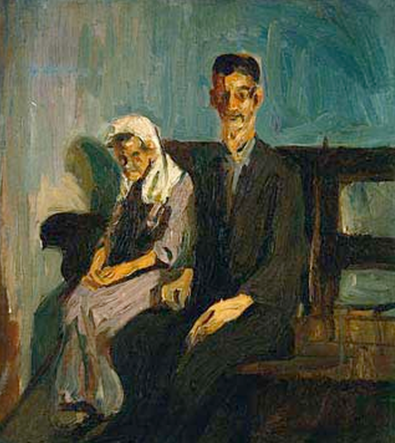
In a time of highly abstract American artists in the 1950’s and 60’s dominated by men like Rothko, Pollock and Still, Alice Neel (1900-1984) painted figurative work in a style reminiscent of the early modernist German Expressionists.  Using color and caricature in a primitive technique, Alice captured the essence of her subjects with their unapologetic gazes at the viewer, using bold colors and expressive brushwork to paint “humanity”.

Eventually, after decades in the wilderness with paintings stacking up four deep against the walls of her Manhattan flat, Neel summoned sufficient courage to approach art-world figures. Their response appears implicit in each portrait. The art critic Gregory Battock takes the opportunity to come out in bright yellow underpants. Frank O'Hara, poet and curator at the Museum of Modern Art, shows his discolored teeth in nervous laughter.

Since Alice’s works did not conform to art world fashions of the times, her early work received little attention or recognition. When the culture of art changed from abstract expressionism and realism to minimalism of the 1970s, Alice remained a figurative artist. She was criticized she went against the social theory that women should or could not be artists and on top of that, a significant number of her paintings were nudes, highlighting individual appearance and real emotions. Many of Neel’s subjects were people she knew or friends. It wasn’t until the 1960’s that significant attention was paid to her work, well over half of which were created after the start of the 1960s, even though she’d been painting continuously throughout her whole life. The decades following her bloom of popularity and attention resulted in many exhibitions, public appearances - even on The Tonight Show with Johnny Carson and many art reviews.

In 1969, Alice received an Arts and Letters award from the American Academy and Institute of Arts and Letters in New York. The following year she was to paint the now famous portrait of Andy Warhol, now to be considered a masterpiece. Depicted with eyes closed and clothed only from the waist down, the painting exposing scars on his body from recent gun shots fired at him, this was one of Neel’s only subjects painted this way. In 1971 Neel was awarded an honorary Doctorate of Fine Arts from Moore College of Art and was elected to the American Academy and institute of Arts and Letters in 1976. Then in 1979, President Jimmy Carter presented Neel with a National Women’s Caucus for Art award for outstanding achievement in art. Famous for asking her sitters to pose nude, in 1980, Neel painted her own self portrait at eighty years old, unsurprisingly in the nude, showing the reality of her body at her age.

Through the later years of Alice’s life, she spent time with her family, traveling to many countries and continents with her sons and also created some paintings which were shown in exhibitions. Then on October 13, 1984 Alice passed away at the age of 84. To this day, her paintings created throughout her lifetime are being exhibited in galleries around the country and world.

Since her death Neel has continued to loom large, and her influence is apparent (if not always immediately obvious) in the work of many contemporary figurative painters. Take the atmosphere of innuendo in Eric Fischl’s suggestive, sexually fraught narratives. Like Neel he is a master of depicting that which is palpable but unspoken.

Neel had a unique way of capturing life in the little moments. Viewers of Neel’s work can feel that they have always known these portraits. This is partly to do with their freight of universal truths and partly to do with Neel's influence, subject of a show of contemporary art at Victoria Miro, “In the Company of Alice”

Some painters – Chantal Joffe, Elizabeth Peyton – have been inspired by the gawky, wry and caricatural aspects of her work; others by the expressiveness and mystery. Peter Doig's painting of his teenage daughter, white legs gleaming in a jungle of dark shadows, shows the influence of Munch on Neel, as much as Neel on Doig. It is not wrong to see her legacy all over the current art scene.
Neel’s approach  presaged the Neo-Expressionist movement by almost 20 years, and after long decades of failure and obscurity finally became regarded as a visionary painter towards the end of her career.  While some categorize her work as “feminist” her life experiences played a formative role in her painting style in a field dominated by men.

By the time of her death in 1984 Neel had won national acclaim as a leading American painter winning awards of recognition in the arts,  a retrospective at the Whitney Museum, and illustrating the cover of Time Magazine. 

Today Neel’s paintings hang in major museums all over the world, along side her early Post Modern contemporaries like Lucian Freud, Francis Bacon and Chuck Close.  Her bold portraits have influenced painters and illustrators for years.  Mother, Wife, Activist, Iconoclast and Artist, Alice Neel was as unique a person as the characters she chose to illustrate.

Beggars 1926 oil painting


Mayor Koch 1981 oil painting


Frank O'Hara 1960 oil painting

Hello!

"What are your defining characteristics as a person?"

Hello! Kaiya here, I enjoy long walks to the fridge, coloring books and black mango tea. I am an enthusiastic individual with a passion for exploring, be it on a bike, in a kayak or tromping around the woods with my big furry adventure buddy [dog], Dakota. I spend far too much time thinking about dogs and puns, and can often times be found laughing at my own jokes. This comes in especially handy after multiple days in the labs, as I work myself into the ground, burritoed up in a blanket animating my soul away..laughing quietly. But! No matter the lack of sleep, amount of work to be done or 200 other things on my brain, I am always willing to support a friend and simply be there for them. I love people. I love laughing, I love animation!


"Tell me about your background and what that means to you?"

Hailing from the state of Minnesota, I grew up constantly surrounded by family, friends and no lack of animals. My mom taught me not to fear bugs, how to pitch a tent and introduced me to our shared love of art. My dad never ceases to make my laugh, has unending wisdom and gave me a terrific love for photography. We're a little family, but there has never been a shortage of noise, road trips, endless photos (comes with the territory of two professional photographers for parents) or impromptu concerts in the kitchen. Being homeschooled, I was able to explore so many more books, take school on the road, live with family in Alaska or spend so much time adventuring all over the woods behind my home or taking countless roadtrips across the US (which were all filled with "field trip" knowledge). It's my favorite place on earth and my favorite place to return to.

"What is your personal foundation and what are you standing on?"

My personal foundation and values are very simple. Make meaningful decisions, do not say what can be understood - say what can't be misunderstood, and above all be kind. My parents gave me a great foundation, setting me up for success so I could make my own observations and decisions about morality and life choices. It is through observation and making my own decisions that I have come to build up my own foundation truths.

"How do your experiences effect how you see the mediascape?"

Along with my own observations and decisions, media sources have made an impact on my life. Through reading works of literature and countless books that give the reader a different perspective on everyday life, I have been been influenced...so partially, the media has changed my perspective on mediascape. I have encountered plenty of bad media in my time, but it has been through finding a "style" of sorts that has helped me filter what I watch or read. I value my time and make conscious decisions when it comes to how I disperse and spend that time - sometimes that means I can go for long periods of time without touching any type of contemporary media. In conclusion, I am on the critical side when it comes to what I intake in terms of media, but am willing to seek out new sources through the course of this class.